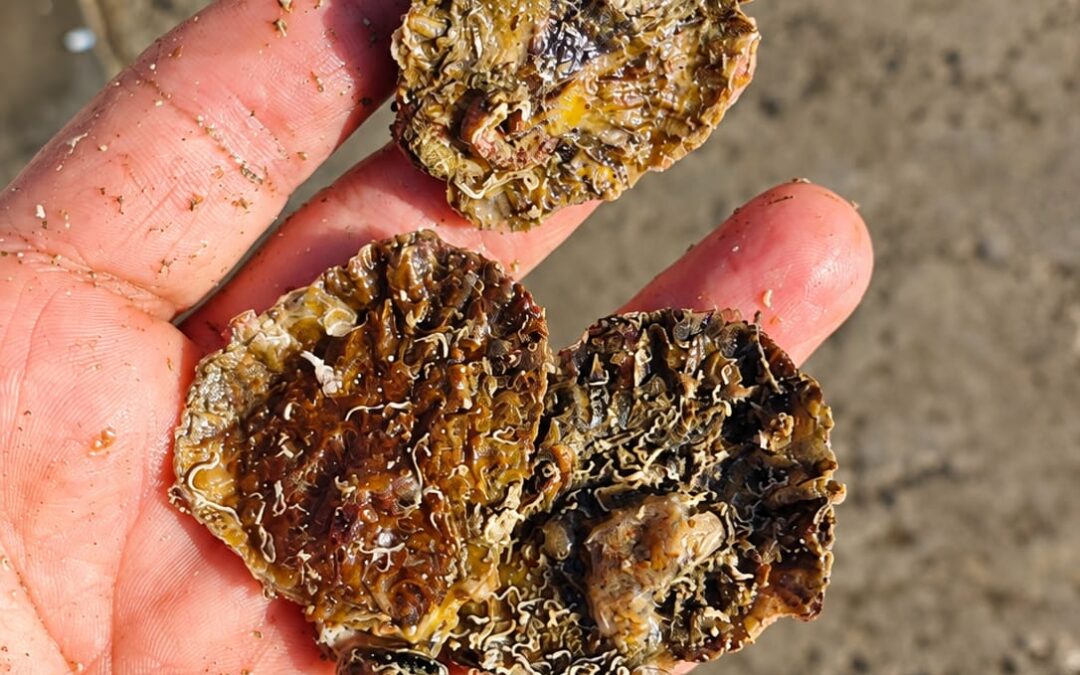
For centuries, European flat oyster (Ostrea edulis) beds were among the most widespread coastal habitats on the Mediterranean seabed. Even in Roman times these molluscs were eaten and farmed: chronicles from the period describe the first oyster farming facilities. By growing on top of one another, oysters build true three-dimensional structures that do a great deal for the ecosystem: they provide shelter and surfaces to settle on for many other species, filter enormous volumes of water, improving its quality, and store carbon in their shells. Over the last century, these beds have almost disappeared from the Mediterranean and the European Atlantic, due to intensive fishing, disease and the degradation of coastal environments caused by human activity. Today the flat oyster is a priority species for restoration across Europe, and its recovery is one of the goals of European biodiversity strategies (fig.1).

Figure 1. Flat oyster in the filed
Good News, and a Knowledge Gap to Fill
In the Gulf of La Spezia the flat oyster is still present, although it no longer forms true habitats. There are no beds: individuals mostly live on their own, attached to ropes, chains and wrecks a few metres below the surface. We still know very little about this population. How many juveniles settle over the course of the year? How fast do they grow? How many survive? How do they react to conditions in the bay and to the changing seasons? Without these answers, a restoration project starts from assumptions rather than measurements and has no way to evaluate its own results.
The Project
This research and doctoral project (Erica Gabrielli) was created precisely to fill this gap. Funded by Italy’s National Recovery and Resilience Plan (PNRR) and developed by ENEA and the University of Milano-Bicocca, the project is part of Smart Bay Santa Teresa cooperation platform. The underlying idea is simple: before intervening on a habitat, we need to understand how the organisms that build it work. The work is organised around four objectives:
- Understanding the Gulf’s population. We follow the settlement of juveniles, as well as growth, survival and the health of adults.
- Understanding how oysters react to heat. An experiment under controlled conditions combines physiological measurements with the analysis of genes that switch on or off when adults are exposed to high temperatures using oyster from Sardinia.
- Studying the shell. We analyse the shell and the organic matrix that guides its construction, an aspect that is still poorly understood in this species and that determines the properties of the material the habitat is made of.
- Comparing wild and hatchery-raised oysters. At the molecular level, we want to understand whether origin and rearing history leave a mark on the way the animal builds its shell using oysters from the Gulf of La Spezia and from Sardinia
Why It Matters for the Bay
Restoring a habitat like this can follow two paths, and the project considers both. The first is supporting natural recruitment, that is, the ability of the existing population to renew itself. Knowing when and where juveniles settle, how quickly they grow and how many survive makes it possible to understand whether the Gulf’s oysters can regenerate on their own once they find a suitable substrate to settle on. The second is the introduction of hatchery-produced individuals, on which most restocking efforts in the Mediterranean are based, in collaboration with IMC Foundation. Here it is essential to understand whether farmed animals are equivalent to wild ones and whether they build the same shell. The data we collect connect directly with other projects active in the bay. Smart Bay Santa Teresa Underwater Observatory continuously measures the physical and chemical parameters of the same sites where the population is monitored, allowing us to interpret biological responses in light of real environmental conditions. The projects Mussel and Oyster Shell for Regeneration and Rentauring the Bay through Circular and Regenerative Nature-Based Solutions have, in turn, placed structures and reefs built with circular approaches in the sea, with the aim of encouraging the repopulation of native species, including the flat oyster. The measurements of settlement, growth and survival collected on natural structures serve as the benchmark for evaluating how the new structures are colonised.

Figure 2. Oyster net for cultivation adapted for the study on local population of the Gulf of La Spezia
Collaborations
The experimental work takes place at the ENEA Santa Teresa Research Centre and the University of Milano-Bicocca, supported by a network of national and international collaborations:
- the Cooperativa Mitilicoltori Associati della Spezia (mussel farmers’ cooperative) contributed to fieldwork in the shellfish farming area;
- the IMC Foundation of Oristano provided support for the study of the hatchery-raised population;
- the University of St Andrews (United Kingdom) and the Université de Bourgogne Europe (Dijon, France), where the molecular analyses are carried out.
Project developed within Ecosistema dell’Innovazione RAISE, funded by European Union – NextGenerationEU, through Ministero dell’Università e della Ricerca (MUR) in the framework of PNRR (Mission 4, Component 2, Investment 1.5 – Project code: ECS00000035) and within National Biodiversity Future Centre (NBFC) funded by the European Union – NextGenerationEU, through Ministero dell’Università e della Ricerca (MUR) in the framework of PNRR (Mission 4, Component 2, Investment 1.4 – Project code: CN00000033)