In the heart of the Smart Bay Santa Teresa – a natural laboratory where scientific research, technology and sustainability meet – sound becomes a tool for reading the territory.
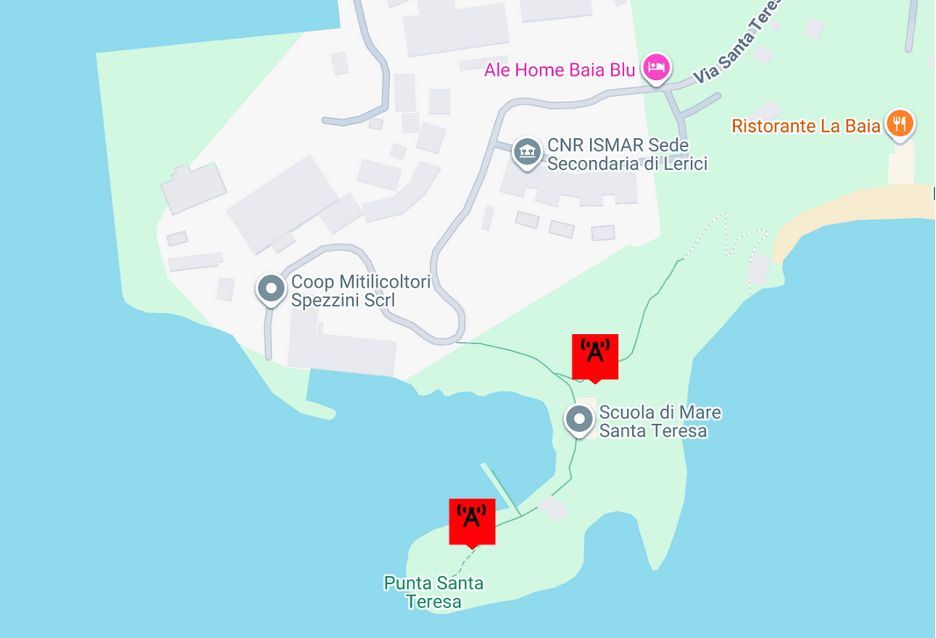
Figure 1 – The Bay of Santa Teresa and the monitoring context: an environment where nature and port activities coexist.
The Bay of Santa Teresa is a unique environment, suspended between nature and port activities: a setting in which marine ecosystems coexist with human pressures. In this delicate balance, the soundscape is a fundamental key to understanding how these two dimensions interact.
The Project “Listening to the Port”
The project, conceived and developed by the CNR – Institute for Computational Linguistics “Antonio Zampolli” (CNR-ILC), aims transforming the sound into knowledge.Traditionally, noise is measured in decibels, but this information alone is not enough: what really matters is how sound is perceived.
“Listening to the Port” therefore proposes an innovative approach that combines two dimensions:
- physical measurements, collected through acoustic sensors
- human perception, collected through online questionnaires
Integrating these two levels makes it possible to build a more complete and realistic representation of the sound environment. This integrated approach overcomes the limitations of traditional measurements: sound is analysed not only as a physical phenomenon, but as a lived experience, influenced by psychological, social and contextual factors.
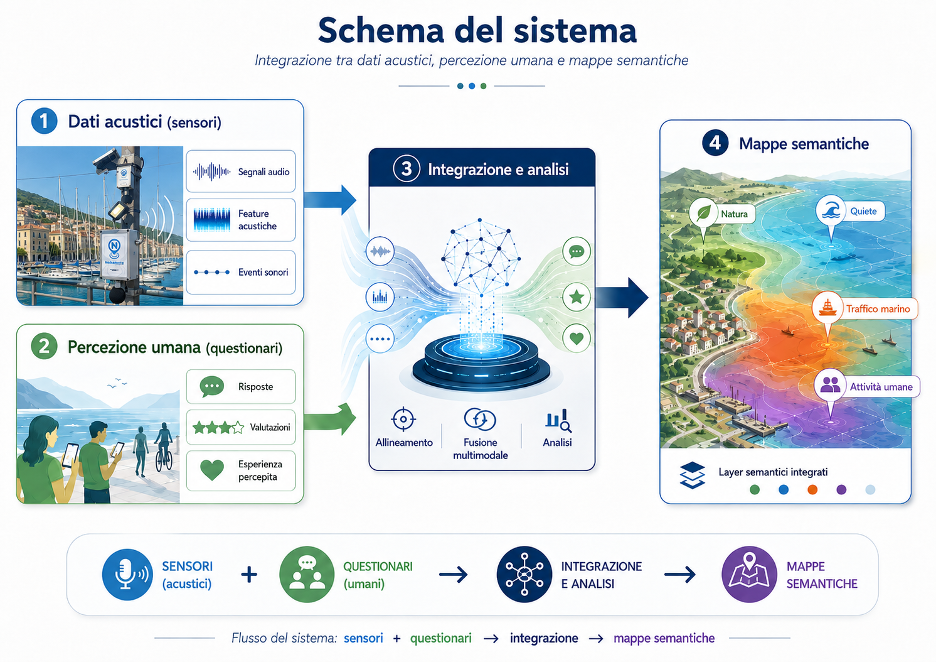
Figure 2 – System diagram: integration of acoustic data (sensors), human perception (questionnaires) and semantic maps.
From Data to Meaning
The innovative contribution of CNR-ILC lies in the use of computational linguistics to interpret sound through language. By analyzing large amounts of Italian-language texts, 476 adjectives related to the concepts of “sound” and “noise” were identified. These terms were selected and organized to describe the sound experience in a structured way. In this way, acoustic data become easier to understand and closer to everyday experience, turning into descriptions such as:
calm, chaotic, pleasant, disturbing.
Monitoring in the Bay
In the Smart Bay Santa Teresa, acoustic monitoring is carried out through sensors installed at strategic points in the bay. The devices continuously record:
- noise levels (dBA)
- equivalent sound level (LeqA)
- variations over time at high resolution
The data are transmitted in real time and collected on a centralized platform, enabling constant analysis of the sound environment.
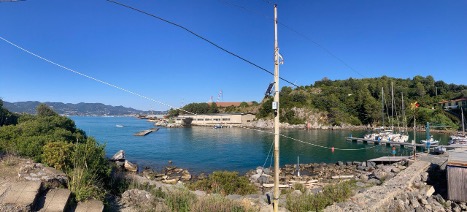
Figure 3 – Acoustic sensor installed in the bay for continuous monitoring of the sound environment.
Maps That Tell the Story of Sound
One of the most innovative elements of the project is the creation of semantic acoustic maps. The territory is divided into areas (hexagonal cells) within which the following are integrated:
- physical noise values
- words and emotions associated by citizens
The result is a map that shows not only how much noise there is, but also how it is experienced.
The maps also make it possible to observe how perception changes over time and space, highlighting patterns linked to human activities and different environmental conditions.
You can explore examples of these maps (created in a port setting) here: https://www.percezione-sonora.it/it/raise
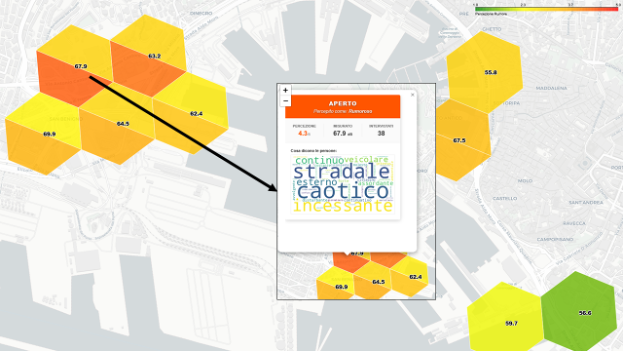
Figure 4 – Example of a semantic acoustic map: each area (hexagonal cell) integrates acoustic data and linguistic descriptions of sound perception.
Citizens’s Role
The project directly involves citizens and port workers through citizen science activities. An online questionnaire, based on the international ISO standard (soundscape), collects:
- descriptions of the sound environment
- qualitative assessments (e.g. pleasant, chaotic, calm)
- reactions to different acoustic stimuli
The questionnaire was administered through the percezione-sonora.it platform and was designed to gather information on two levels: the assessment of the real sound environment at the time and place of the interview, and the assessment of specific audio tracks. This structure therefore makes it possible to compare situated perception with perception mediated by listening to recordings, adding the perceptual dimension to the technical data.
What Sound Teaches Us
The analyses show that noise is not just a matter of intensity. At equal sound levels:
- some environments are more acceptable than others
- context strongly influences perception
- perceived quality is closely tied to the meaning attributed to sounds
The initial analyses also show that environments with similar sound levels can be perceived very differently: this confirms that the quality of the sound environment also depends on people’s context and expectations.
Why It Matters
“Listening to the Port” contributes to the goals of the Smart Bay by providing useful tools to:
- support the decisions of administrations and stakeholders
- improve urban and coastal planning
- develop new scientific knowledge on the relationship between sound and perception
Understanding the soundscape means designing more livable and sustainable environments.
Outlook
The activities in the bay are a first step toward increasingly integrated monitoring. Future developments include:
- integration with other environmental data
- broader citizen participation
- evolution of the maps and analysis tools
The goal is to build an ever more complete picture of the relationship between environment, technology and perception.
How to Contribute
Contributing is easy: just fill in one of the online questionnaires (only one, and only once per person).
- https://www.percezione-sonora.it/surveymanager/40#/
- https://www.percezione-sonora.it/surveymanager/41#/
To explore the results:
For more information: Davide Chiarella at the Institute for Computational Linguistics “Antonio Zampolli”, Genoa branch (UoS).
Project funded by RAISE Innovation Ecosystem, funded by the European Union – NextGenerationEU, through the Ministry of University and Research (MUR) under the PNRR (Mission 4, Component 2, Investment 1.5 – Project code: ECS00000035).